

Maker in Conversation: O. St x Gemma O’Brien
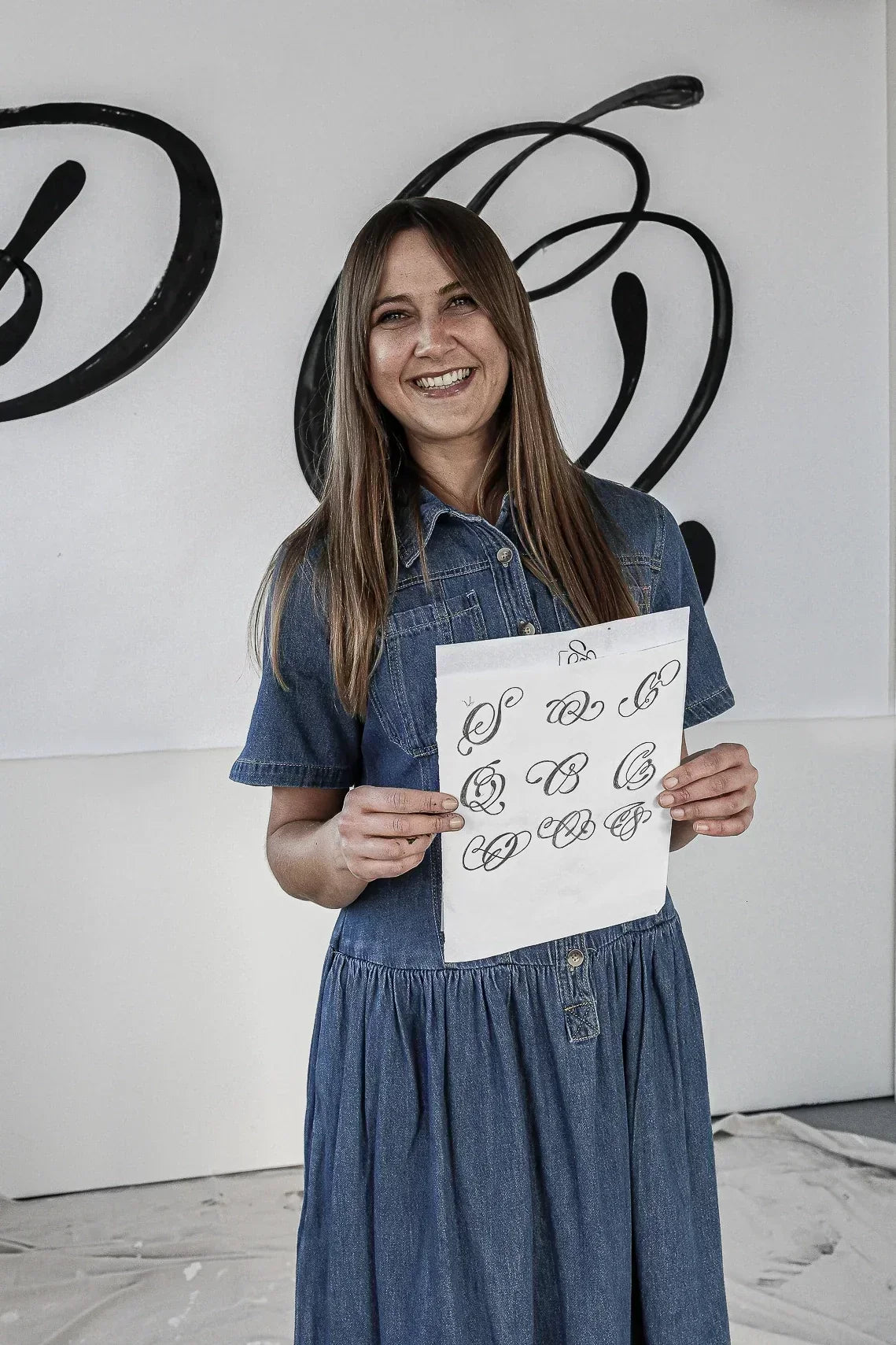
Gemma, we are so honoured to have your hands bringing the We Are Nature alphabet to life. There is something so incredibly moving about taking something as familiar as letters and transforming them into an expression of the natural world.
What first drew you to lettering, and what continues to inspire you about creating words by hand?
I guess my inspiration has always come from two things: nature and science, or letters in the world. I always think of letters as the human side and plants and nature as the other side. Both of those things together have always inspired my practice.
For this particular project, it was about making the link between these vines, which look calligraphic in the way they grow, and thinking about how they could be transformed into letterforms that would fit with the Orchard St branding.
Your work has always explored the relationship between language, movement and visual storytelling. With your research into neuroaesthetics, I’d love to know: what fascinates you about the way we experience visual forms?
I began this new adventure into the world of neuroaesthetics from a desire to add a theoretical component to my practice, which had always been driven by the body, calligraphy, painting and the physical act of making. I thought, what does the science say? What happens in our brains and bodies when we experience beauty or create something?
Interestingly, when I began the academic work, it made me fall back in love with the handmade process, getting out of the head and back into the physical. But they can inspire each other.
One of the biggest things about neuroaesthetics is that it studies the brain, the body and beauty in relation to aesthetic theories, such as art history or how we look at a painting. But the same applies to nature. You can experience awe when you look at a big mural, but you can also, and probably more readily, experience awe when you’re at the top of a mountain. These experiences often surprise you. I’m always trying to find ways to recreate that in my work and asking: can we actually compete with nature?
The We Are Nature alphabet is rooted in the idea that we are not separate from the natural world, but an expression of it. When you hear the words “We Are Nature”, what do they evoke for you?
When I think of “We Are Nature”, there’s the beautiful side of it: that we create things intuitively without necessarily knowing why we do them. Why did we come up with an alphabet, a series of symbols to communicate with one another? And why did we then go another level beyond that and create different styles of alphabets? It’s a form of human expression.
But when I think of nature, it has not only a beautiful side but also an unpredictable side. If you go hiking, you can be inspired and feel refreshed, but you can also be threatened by rain and wind. There’s a real reality to what nature is, and I think humans are the same. We have all these different parts and we’re not perfect, but through calligraphy and expression, we have a way to push ourselves towards our potential.
That is, I think, my favourite thing about being human. You can be inspired by nature while accepting that it’s not always going to be a smooth, clean path.
There is such a beautiful contrast between the precision of typography and the organic nature of hand-drawing. How do you find the balance between structure and flow in your creative process?
One of the reasons I’m drawn to typography is that it has an underlying structure and rules that you can learn. There are optical tricks. If you look at an O sitting on a baseline and it isn’t hanging slightly below it, it can appear to be floating. If you have skills in the craft of typography, you know these tricks for making something look well crafted.
Then there’s the other side of calligraphy, which doesn’t feel as rule-based and can be more fluid. I think combining those two things is where the sweet spot lies. Free, abstract expression is beautiful, but it might not necessarily communicate anything. Typography and calligraphy are the perfect marriage of freedom and control, and structure and fluidity. That balance between the two is always interesting to me.
Nature is such a deep source of inspiration for so many creatives. Is there a landscape, place or moment in nature that continually returns to you?
The place I always return to is Otford in the Royal National Park. I had always known about that coastline and the coastal track, but I really got into hiking there just after the COVID period, around 2020 and 2021.
You would arrive in Otford after this hike, chasing the sunset, and it would be this beautiful thing. Now, whenever I need to escape the city or refresh, that’s always the place I return to.
The act of creating can feel almost meditative, a conversation between your hands, your mind and something beyond yourself. Have you experienced moments where it feels less as though you are making and more as though you are listening or receiving?
Yes. It’s funny because, especially after having a long career, I sometimes forget about that magical period. I get so immersed in a process that I repeat that the magical part can feel quite distant. But it often takes me by surprise, and it usually comes after a longer period of working slowly or repetitively, over a number of days or late into the night.
It’s a bit like a flow state: when you realise it’s happening, it’s gone. I think it still exists. I studied flow states when I was doing my neuroaesthetics research, and I had this moment when I thought, should I stop the scientific side of it there? Maybe there are certain things we should leave unexamined. Why do we need to prove it? We all know these things happen.
I don’t know if I tap into any particular power beyond myself, but I know the feeling when the mind and body are in sync. It feels as though the hand is doing its own thing. Especially with calligraphy: if I draw a Y and begin a swash, there are a few different options. I can loop it back or finish it there. But every now and then, I think, I’m just going to see what happens. I don’t know until it shows me. It’s pretty cool.
Looking at the alphabet as a whole, with each letter becoming its own little ecosystem, what do you hope people feel when they interact with it?
Firstly, I hope people are drawn into it. We see so many letters and words every day that it’s easy to forget we can even read, or to notice that these are little design features.
I hope people are drawn in, feel curious and pay attention to the shapes, perhaps entering one of these weird, curly little worlds that emerged through the process of creating them.
Rapid Fire
What is We Are Nature to you?
A reminder of who we are and that everything is connected.
A creative who inspires you:
Hilma af Klint.
A book that has shifted your perspective:
Either The Art Spirit or The Art Instinct. One is a book by a painter and the other is by a scientist and evolutionary biologist.
A daily ritual you return to:
A swim in the ocean, hot or cold, at any time of the year.
Read more
I hope you are ready for some transformation because we have a big month ahead in the sky! Our final Leo-Aquarius eclipse season opens on 6 August, with the new moon solar eclipse landing on 13 Au...
You might be wondering why Orchard St. now includes skincare alongside the plant medicines you've always known us for. Perhaps another question worth asking is what we mean when we speak of beauty ...


